Neues aus dem Expeditionsblog der Phoenician:
Blog from Yuri Sanada (Film maker & core crew)
We are sailing for a week now, still trying to get as far east as possible, before we turn and head south. The reason is obvious if you are following our voyage around Africa, to avoid the dangerous waters around Somalia, presumably infested with pirates. Unfortunately, we are not making as much progress as we planned in the beginning. So we are taking our time, and enjoying the simple but meaningful pleasures this water world can offer to us.
First of all, we have freedom. Not the same kind of freedom you have back home of course. Our world now is limited by the area of the ship, but even with a crew of 11, everybody seems to find his own private corner when comes the need to be alone. Our freedom here is more like no appointments, no need to go to the grocery store, no phone calls, no salesman at the door (however we did encounter a medium size shark the other night), and no schedules outside our environment.
We do have obligations, but they come naturally, like keeping the boat afloat and moving towards our destination. For that, we are divided in two groups, 5 people each, and the captain, Philip, showing up every time he is needed. Our watches are 4 hours during the day, and 6 hours at night, so everybody can get a longer sleep time.
While this Phoenicia Expedition is voyage of discovery, trying to prove that the Phoenicians had technology and skills to sail around Africa, it is also a voyage of self discovery, as we are exposed to different cultures aboard.
Our group in this leg is composed of five sailors from the Royal Omani Navy, three Indonesians, and three westerners, from England, Sweden and Brazil.
The food varies each time there is a different nationality cooking, and you can, sometimes, really taste how "hot" the difference may be. Water is a major issue for us now. We are carrying three thousand litres, but we didn't calculate the need of eight Muslim crew members to wash with fresh water five times a day, before they put their rugs towards Mecca to pray. They could use up to 1/3 of our total supply just to fulfil their religious obligation. So, as good comrades, we all are adapting to this new situation, and agreed to save more water, maybe by using more seawater for cooking and washing.
The differences fall apart when we have to work together to achieve a common goal, like raising the main sail, that weights over a ton, and when we change watches, and everybody has a meal together. So we go, sailing along, being creative in the kitchen, pumping water from our bilge, adjusting the sails, and looking out trying to decide if that dot on the horizon is a star, a friendly cargo ship, or maybe a pirate vessel waiting for us.
Talking about that, it's funny the way the cargo ships seem to accelerate when they see us. I don't blame them, for a replica of a 2500 Phoenician Ship must look like a pirate ship to them.
We continue on this long leg towards Tanzania, playing pirates, and praying not to meet the real ones. Yo ho ho, a pirates life for me.
Gruß
Micha
Rund um Afrika in einem phönizischen Boot
Moderator: Moderatoren


-
mikepiller
- Beiträge: 952
- Registriert: Sa 13. Mai 2006, 20:59
- Wohnort: Berlin
-
mikepiller
- Beiträge: 952
- Registriert: Sa 13. Mai 2006, 20:59
- Wohnort: Berlin
Re: Rund um Afrika in einem phönizischen Boot
(Der Rest der Übersetzung von Nick)
Ihr habt nach „Wiedergeburt der Geschichte“ gefragt.
(Micha: Ich habe gefragt, was es für ein Gefühl ist, wenn Geschichte sozusagen lebendig wird, wenn etwas längst verrottetes wieder irgendwie aufersteht, wieder geboren wird...)
„Lebendige Geschichte“ und „experimentelle Archäologie“ sind ebenfalls Begriffe, die diese Art des "nachkreieren" von vergangenen Aspekten über seriöse akademische Gründe benennen.
Es ist ein Thema, über welches ich manchmal schreibe oder Vorlesungen halte. Tatsächlich werde ich nächste Woche darüber in einer Konferenz in Beijing, China, reden.
Einer der Basis- Grundsätze ist- meiner Meinung nach- das experimentelle Archäologie bei der Benutzung von Repliken und Nachbauten von Wasserfahrzeugen zu teuer ist als das die meisten Museen und Universitäten dem nachgehen könnten.
Glücklicherweise werden Schiffsreplik-Projekte aus anderen Gründen initiiert. Die Herausforderung und passende Gelegenheit ist für die Archäologie ein Involviert sein in Wegen, die die Replikprojekte authentisch machen, z.B. gute Recherche, ohne die anderen Ziele des Projekts " anzugreifen".
Ich persönlich bin an Schiffsreplik-Projekte beteiligt gewesen, weil ich obsessiv interessiert bin an traditionellen Segelschiffen und ihrer unterschiedlichen Art des Segelns (?)-
seit ich ein Kind war. Ich weiß nicht weshalb.
Es ist kein guter Pfad um Karriere zu machen, aber sehr interessant für mich. Wenn ein Schiffsreplik gut durchgeführt wird, ist es befriedigend. Das Duyfken Replik und das Borobudur Schiff sind beide sehr gut durchgeführt worden.
Genug für heute, denke ich,
Nick Burningham
-
Alexander
- Administrator
- Beiträge: 24239
- Registriert: Sa 30. Jul 2005, 19:12
- Wohnort: Dubai/Vereinigte Arabische Emirate
- Kontaktdaten:
Re: Rund um Afrika in einem phönizischen Boot
Hello Nick,
thanks for spending your time to answer our questions and bringing us closer to your journey and our ancient history. I personally never had the opportunity to sail away even with a modern ship, but I can imagine this is a remarkable adventure for you and the crew. Hence, we really appreciate your patience giving us an insight and allowing us to participate in the journey, at least from a remote point of view.
What I am interested in to learn, how much time did it take from the moment, where somebody said: hey, I have an idea. We build a ship and sail around Africa, until the ship and the crew was ready to hit the sea? I can imagine there is a lot of planning and investigation prior of going live with this idea.
I am looking forward to hear from you again.
Smooth sailing and best regards
Alexander
thanks for spending your time to answer our questions and bringing us closer to your journey and our ancient history. I personally never had the opportunity to sail away even with a modern ship, but I can imagine this is a remarkable adventure for you and the crew. Hence, we really appreciate your patience giving us an insight and allowing us to participate in the journey, at least from a remote point of view.
What I am interested in to learn, how much time did it take from the moment, where somebody said: hey, I have an idea. We build a ship and sail around Africa, until the ship and the crew was ready to hit the sea? I can imagine there is a lot of planning and investigation prior of going live with this idea.
I am looking forward to hear from you again.
Smooth sailing and best regards
Alexander
The one who follows the crowd will usually go no further than the crowd. Those who walk alone are likely to find themselves in places no one has ever been before.
· · · Wüstenschiff-Veranstaltungsübersicht 2026 —> Alle Reise-Events auf einen Blick - Check it out !!!
· · · · · Werde Wüstenschiff-Werbepartner —> Firmen, die Wüstenschiff-Aktionen in Afrika unterstützen
· · · · · · · Geschlossene Gruppen —> Die neue Wüstenschiff-Funktion
· · · Wüstenschiff-Veranstaltungsübersicht 2026 —> Alle Reise-Events auf einen Blick - Check it out !!!
· · · · · Werde Wüstenschiff-Werbepartner —> Firmen, die Wüstenschiff-Aktionen in Afrika unterstützen
· · · · · · · Geschlossene Gruppen —> Die neue Wüstenschiff-Funktion
-
Regula St.
- Beiträge: 469
- Registriert: Sa 10. Mai 2008, 18:00
- Wohnort: Küssnacht am Rigi
Re: Rund um Afrika in einem phönizischen Boot
quarters müsste in diesem Zusammenhang Achterdeck bedeuten; die Ruder befinden sich auf beiden Seiten des Schiffs etwas vor dem Achtersteven (bitte korrigiert mich, wenn ich da was Falsches sage, mein schiff-technisches Wissen ist beschränkt!).Das Borobudur Schiff hatte ähnliche Ruder an den „quarters“
(? Bitte um Erklärung, wenn jemand Ahnung hat))
befestigt.
@ Micha:
All diese Hintergrundinfos, die Du für uns organisiert hast und organisierst, sind hochspannend und sehr informativ. Du machst Dich damit sehr verdient! Ein herzliches Dankeschön an Dich und vor allem auch an Nick, der klar unterscheidet zwischen (hypothetischer) Rekonstruktion und Replikat und dies auch im Hinblick auf den Bau der Phoenicia darlegt. Ich warte gespannt auf weitere Infos.
LG Regula
-
schu achbar ?
Re: Rund um Afrika in einem phönizischen Boot
Hi Regula, ich denke Du hast das richtig erklärt.
Grosses Dankeschön an Micha, dass er sich erfolgreich um Nick als Schreiber
bemüht hat. Ideen hast Du vielleicht :D .
Das haut mich ja echt um.
Big Thanks to Nick for giving us first hand insight into that matter.
.
Grosses Dankeschön an Micha, dass er sich erfolgreich um Nick als Schreiber
bemüht hat. Ideen hast Du vielleicht :D .
Das haut mich ja echt um.
Big Thanks to Nick for giving us first hand insight into that matter.
.
-
mikepiller
- Beiträge: 952
- Registriert: Sa 13. Mai 2006, 20:59
- Wohnort: Berlin
Re: Rund um Afrika in einem phönizischen Boot
@ Regula:
Thanks to Regula for the comment about "replicas" and "hypothetical reconstructions".
Unfortunately the English speaking public accept the word "replica" and misunderstand "reconstruction". When I said that we were building a reconstruction of Duyfken, many people thought we had found a shipwreck and were repairing it!
Hypothetical reconstructions can be used in respectable and useful research. You can find a three papers about the Duyfken project in the International Journal of Nautical Archaeology.
Dank an Regula für den Kommentar über „Repliken“ und „hypothetische Rekonstruktionen“. Unglücklicherweise akzeptiert das englischsprachige Publikum eher das Wort „Replik“ und missversteht „Rekonstruktion“. Als ich sagte, dass wir eine Rekonstruktion der Duyfken machen, dachten viele Leute, dass wir ein Schiffswrack gefunden hätten und es nun reparieren würden!
Der Bergriff Hypothetische Rekonstruktion kann nach anständiger und korrekter Nachforschung benutzt werden. Du kannst einen drei Seiten Bericht über das Duyfken Projekt in dem International Journal of Nautical Archaeology finden.
Nick Burningham
@ Alex:
Very nice pictures of the desert, Alexander.
I lived in Oman for two years (reconstructing the design of traditional Arabian watercraft and building models for a new museum). I remember spectacular desert and mountain scenery, and the tiny fragile wadis at the bottom of huge canyons.
Sehr schöne Bilder aus der Wüste, Alexander.
Ich habe zwei Jahre in Oman gelebt (ich habe dort das Design traditioneller arabischer Wasserfahrzeuge rekonstruiert und Modelle für ein neues Museum gebaut). Ich erinnere mich an spektakuläre Wüsten- und Gebirgsszenen, und an die kleinen, zerbrechlichen Wadis auf dem Grund gewaltiger Canyons.
Nick Burningham
(Die Antwort auf die Frage von Alex ist in Arbeit)
-
mikepiller
- Beiträge: 952
- Registriert: Sa 13. Mai 2006, 20:59
- Wohnort: Berlin
Re: Rund um Afrika in einem phönizischen Boot
About your question, Alex:
How long does it take to get a replica ship expedition under sail?
It can be quite fast if the money is available. The two difficult aspects are finding the money and finding the timber.
It was in October 2002 that I met with Phillip in London and he commissioned me start work on the design. I had given some thought to the design of the Borobudur ships in previous years and had the literature in my files, so we were not starting from zero.
The ship was launched in May 2003, first sailed in June, and departed Jakarta for the official start of the expedition in August. Reached the Seychelles a month later -- less than a year after the decision to start.
The Phoenicia project was not quite so quickly realised. I'm not sure when Phillip initiated design work. However, he engaged modern naval architects who designed a modern yacht with a bit of Phoenician styling.
In effect it was a false start. The earliest Phoenicia document I have on-file is from February 2007. Construction started in November 2007, at which time detail of the design was still being worked on. The ship was launched in late July 2008, and first sailed a month later. The design was based on research and reconstruction of design that was done by other people (Prof Patrice Pomey and others) before the Phoenicia project was started.
If one were to look at the timeline of a project building a replica based on a shipwreck, the timeline from the discovery of the wreck to sailing the replica would be much longer (e.g. the Kyrenia ship).
It could be argued that Phoenicia was not ready to sail when she was towed to Suez and through the canal. Initial sailing on the Red Sea was chaotic and could have been disastrous.
I am not sailing on Phoenicia. I don't think Phillip would want me.
My ideas about how these things should be done are different from his.
Anyway, planning for the voyage should be done during the time when the ship is being built. You don't want the ship lying around doing nothing after launching. An unused wooden ship quickly deteriorates.
A bigger project: the Duyfken replica. Research for the design had been started back in the early 1990s, but it was early 1996 when I started working full-time on the design. Late in 1996 I went to Latvia to source oak timber. Early 1997 construction started. Launching was two years later (early 1999). First major voyage started April 2000.
Best regards
Nick Burningham
- - -
Zu Deiner Frage, Alex:
Wie lange es dauert bis eine Schiffsreplik- Expedition die Segel hissen kann?
Es kann sehr schnell gehen wenn das Geld verfügbar ist.
Die zwei schwierigsten Aspekte sind das Auftreiben des Geldes und des Bauholzes. Es war im Oktober 2002, als ich Phillip in London traf und er mich beauftragte, mit dem Entwurf zu beginnen. Ich hatte mir in früheren Jahren schon Gedanken über die Borobudur Schiffe gemacht und hatte die passende Literatur in meinen Dateien, wir haben also nicht bei Null angefangen.
Das Schiff wurde im Mai 2003 ins Wasser gelassen, segelte das erste Mal im Juni und verließ Jakarta am offiziellen Start der Expedition im August. Es erreichte die Seychellen einen Monat später- weniger als ein Jahr nach der Entscheidung des Arbeitsbeginns.
Das Phoenicia Projekt war nicht so schnell realisiert. Ich bin mir nicht sicher, wann Phillip die Entwurfarbeiten initiierte. Allerdings engagierte er „moderne“ Schiffsarchitekten, die eine moderne Jacht mit etwas phönizischem Design entwarfen. In der Tat war es ein falscher Start.
Das erste Phoenicia Dokument, welches ich habe, ist von Februar 2007. Die Konstruktion begann im November 2007, während noch an Details des Entwurfes gearbeitet wurde. Das Schiff wurde im Juli 2008 zu Wasser gelassen und segelte zum ersten Mal einen Monat später. Das Design beruhte auf Nachforschungen und Rekonstruktionen von Entwürfen, welche andere Leute gemacht hatten (Prof. Patrice Pomey und andere) bevor das Phoenicia Projekt begann.
Wenn man die Zeitspanne eines Projekts betrachtet, welches (exakte) Repliken- basierend auf Schiffswracks- anfertigt: Es dauert deutlich länger von der Endeckung des Wracks bis diese Replik segeln kann (das Kyrenia Schiff z.B.).
Man könnte darüber streiten, ob die Phoenicia noch nicht segeltauglich war, als sie nach Suez und durch den Kanal gezogen wurde. Das erste Segeln auf dem Roten Meer war chaotisch und hätte katastrophal werden können.
Ich bin nicht auf der Phoenicia gesegelt. Ich glaube nicht, dass Phillip mich würde haben wollen. Meine Ideen über den Ablauf all dieser Dinge waren anders als seine.
Überhaupt: Das Planen der Reise sollte in jener Zeit gemacht werden, in der das Schiff gebaut wird. Du willst das Schiff nicht untätig herum dümpeln sehen, nachdem es zu Wasser gelassen wurde. Ein unbenutztes Holzschiff geht schnell kaputt.
Ein größeres Projekt: das Duyfken Replik.
Nachforschungen über den Bauplan begannen schon in den frühen Neunzigern, aber Anfang 1996 begann ich, Ganztags an den Entwürfen zu arbeiten. Ende 1996 ging ich nach Lettland um Eichenholz zu besorgen. Anfang 1997 begann der Bau. Zwei Jahre später (Anfang 1999) wurde die Duyfken zu Wasser gelassen. Die erste große Reise begann im April 2000.
Viele Grüße
Nick Burningham
Wenn der Wind des Wandels weht,
bauen die einen Windmühlen,
die anderen bauen Mauern.
(chin. Sprichwort)
bauen die einen Windmühlen,
die anderen bauen Mauern.
(chin. Sprichwort)
-
mikepiller
- Beiträge: 952
- Registriert: Sa 13. Mai 2006, 20:59
- Wohnort: Berlin
Re: Rund um Afrika in einem phönizischen Boot
Position Report 58
Date: 3rd November
Location: 12.58.00N, 57 47.0 E
Message: Blog 4- Day nine on Indian Ocean
Blog from Crew member: Niklas Andersson
We have just hoisted the mainsail and we are really tired. It took a lot of effort from everyone to get it up. But the decision was right to hoist it. The last days we have struggled with the storm sail to get more east and away from Somalia without any success. And when the wind got a bit stronger Philip decided to try the mainsail again. Now we are racing down the Indian Ocean in almost 4 knots going southeast. The feeling to sail with the mainsail is great. It must be a beautiful sight from a distance. This is how sailing is supposed to be. Soon there will be lunch and our favourite cook Aziz is making spicy food again. Without chilli I hope!
Philip is now in an unthreatened position in the fishing competition. He has now caught six and Dirman is on second place with two. Thought Dirman almost caught a shark a few days ago. A beast, almost 1.5m between the eyes.
We were just about to drag the beast aboard when the hook snapped and it got away. The fresh food is about to go off now. Though we have lots of canned food left and the eggs are now covered with Vaseline to keep them fresh for the whole leg to Dar Es Salaam. Oh now something is happening. The parell just snapped and the yard is flapping lose and away from the mast. No time to rest, All hands on deck!
Captain's Blog-
Sailing Close to the Wind.
As you will know from earlier blogs we have been trying to make progress to the east of us to avoid the pirates. However this has been difficult because as everyone one knows, Phoenician ships couldn't sail close to the wind, anything under 90 degrees is considered good. And with light north easterly winds we have only managed to go due south or worse these last couple of days. We are therefore sailing close to the wind in the metaphorical sense, as we are just some 450 miles from the Somali coast and the security advisers recommend a minimum distance of between 600 and 900 miles offshore because of the almost daily attacks taking place.
The good news is that in the last 24 hours the winds have freshened (12-15 knots) and with the mainsail now up, we are starting to make a little headway to the east and over 3 knots total speed. Tonight we expect even stronger winds and faster progress. But as far as other risks go we are still sailing pretty close to the wind and a little too close to the Somali coast for comfort. That having been said most of the recent attacks have been several hundreds of miles to the south of us, something to worry about next week perhaps. In the meantime we are, for the first time in a long time, enjoying some magnificent sailing. The shape of the mainsail is a fantastic sight and we are all happy to be part of the experience.
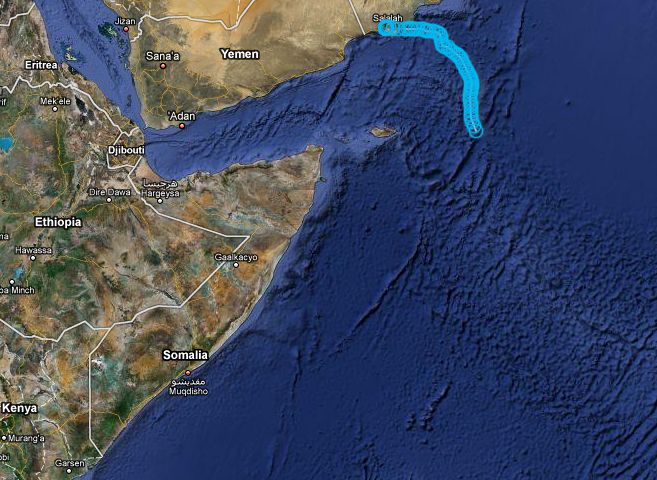
Date: 3rd November
Location: 12.58.00N, 57 47.0 E
Message: Blog 4- Day nine on Indian Ocean
Blog from Crew member: Niklas Andersson
We have just hoisted the mainsail and we are really tired. It took a lot of effort from everyone to get it up. But the decision was right to hoist it. The last days we have struggled with the storm sail to get more east and away from Somalia without any success. And when the wind got a bit stronger Philip decided to try the mainsail again. Now we are racing down the Indian Ocean in almost 4 knots going southeast. The feeling to sail with the mainsail is great. It must be a beautiful sight from a distance. This is how sailing is supposed to be. Soon there will be lunch and our favourite cook Aziz is making spicy food again. Without chilli I hope!
Philip is now in an unthreatened position in the fishing competition. He has now caught six and Dirman is on second place with two. Thought Dirman almost caught a shark a few days ago. A beast, almost 1.5m between the eyes.
We were just about to drag the beast aboard when the hook snapped and it got away. The fresh food is about to go off now. Though we have lots of canned food left and the eggs are now covered with Vaseline to keep them fresh for the whole leg to Dar Es Salaam. Oh now something is happening. The parell just snapped and the yard is flapping lose and away from the mast. No time to rest, All hands on deck!
Captain's Blog-
Sailing Close to the Wind.
As you will know from earlier blogs we have been trying to make progress to the east of us to avoid the pirates. However this has been difficult because as everyone one knows, Phoenician ships couldn't sail close to the wind, anything under 90 degrees is considered good. And with light north easterly winds we have only managed to go due south or worse these last couple of days. We are therefore sailing close to the wind in the metaphorical sense, as we are just some 450 miles from the Somali coast and the security advisers recommend a minimum distance of between 600 and 900 miles offshore because of the almost daily attacks taking place.
The good news is that in the last 24 hours the winds have freshened (12-15 knots) and with the mainsail now up, we are starting to make a little headway to the east and over 3 knots total speed. Tonight we expect even stronger winds and faster progress. But as far as other risks go we are still sailing pretty close to the wind and a little too close to the Somali coast for comfort. That having been said most of the recent attacks have been several hundreds of miles to the south of us, something to worry about next week perhaps. In the meantime we are, for the first time in a long time, enjoying some magnificent sailing. The shape of the mainsail is a fantastic sight and we are all happy to be part of the experience.
Zuletzt geändert von mikepiller am Di 3. Nov 2009, 18:59, insgesamt 1-mal geändert.
Wenn der Wind des Wandels weht,
bauen die einen Windmühlen,
die anderen bauen Mauern.
(chin. Sprichwort)
bauen die einen Windmühlen,
die anderen bauen Mauern.
(chin. Sprichwort)
-
Alexander
- Administrator
- Beiträge: 24239
- Registriert: Sa 30. Jul 2005, 19:12
- Wohnort: Dubai/Vereinigte Arabische Emirate
- Kontaktdaten:
Re: Rund um Afrika in einem phönizischen Boot
Hello Nick,
thanks for your explanation and your compliments regarding my pictures. It was my small adventure, breaking out from ‘normality’ and civilisation. I enjoyed my trip indeed.
I can imagine it is not easy to accomplish a project like this. Many experts and many different opinions and strategies. When I understood you correctly, initially you just had the wrecks, relying on some old, decomposed planks. And then projected an image on how the ship may have been shaped 1500 or 2000 years ago. It is quite a remarkable achievement and I envy you for being a part of this great adventure.
It will become interesting when Phoenicia will sail around the Cape of the Good Hope, an area, which was feared by the old ships and the crews. A lot of sailors and ships experienced their adventure there in the past and many of them left their lives.
A fair wind
Alex
thanks for your explanation and your compliments regarding my pictures. It was my small adventure, breaking out from ‘normality’ and civilisation. I enjoyed my trip indeed.
I can imagine it is not easy to accomplish a project like this. Many experts and many different opinions and strategies. When I understood you correctly, initially you just had the wrecks, relying on some old, decomposed planks. And then projected an image on how the ship may have been shaped 1500 or 2000 years ago. It is quite a remarkable achievement and I envy you for being a part of this great adventure.
It will become interesting when Phoenicia will sail around the Cape of the Good Hope, an area, which was feared by the old ships and the crews. A lot of sailors and ships experienced their adventure there in the past and many of them left their lives.
A fair wind
Alex
The one who follows the crowd will usually go no further than the crowd. Those who walk alone are likely to find themselves in places no one has ever been before.
· · · Wüstenschiff-Veranstaltungsübersicht 2026 —> Alle Reise-Events auf einen Blick - Check it out !!!
· · · · · Werde Wüstenschiff-Werbepartner —> Firmen, die Wüstenschiff-Aktionen in Afrika unterstützen
· · · · · · · Geschlossene Gruppen —> Die neue Wüstenschiff-Funktion
· · · Wüstenschiff-Veranstaltungsübersicht 2026 —> Alle Reise-Events auf einen Blick - Check it out !!!
· · · · · Werde Wüstenschiff-Werbepartner —> Firmen, die Wüstenschiff-Aktionen in Afrika unterstützen
· · · · · · · Geschlossene Gruppen —> Die neue Wüstenschiff-Funktion
-
mikepiller
- Beiträge: 952
- Registriert: Sa 13. Mai 2006, 20:59
- Wohnort: Berlin
Re: Rund um Afrika in einem phönizischen Boot
Hi,
Bevor Nick nach China aufgebrochen ist, um dort unter anderem einen Vortrag über-
ich wiederhole dies mit einem leichten Grinsen-
die Unterschiede zwischen einer Replik und einer Rekonstruktion zu halten…
hat er uns noch einen Hinweis dagelassen:
Hi
Euch könnte vielleicht auch noch das "Jewel of Oman" (Juwel des Omans) Projekt interessieren.
http://www.jewelofmuscat.tv/
Ich habe diese Replik entworfen. Die Website erzählt leider nicht viel über die Archäologie, die hinter dem Projekt steht.
Es basiert auf einem Schiffswrack das 1998 auf der Insel Belitung in Indonesien gefunden wurde. Die Fracht bestand zum größten Teil aus Porzellan aus der chinesischen Tang Dynastie-
um die 60 000 Stücke.
Die Schiffskonstruktion deutet darauf hin, dass es aus Arabien, Persien oder Indien stammt. Analysen des Holzes zeigten zudem auf, das ein großer Teil davon einer Spezies angehört, die nur in Afrika wächst, also ist es wahrscheinlich eher ein arabisches oder persisches Schiff als ein indisches.
Es gibt Theorien, dass dieses Schiff aus Südostasien entstammt, da südostasiatisches Werkzeug es in Stand gehalten zu haben scheint.
In jedem Falle ist eine sehr deutliche Verbindung, eine frühzeitliche „Globalisierung“ zwischen Arabien und Asien impliziert.
Nick Burningham
- - -
Hier noch ein Link zu einem auch bebilderten BBC- Artikel über das Wrack und seine Ladung
http://news.bbc.co.uk/2/hi/programmes/f ... 675866.stm
Hier ein weiterer Artikel mit Bildern der äußerst gut erhaltenen Ladung
http://idlethink.wordpress.com/2009/07/ ... pores-past
Und hier ein Wiki über chinesisches Porzellan, auch in Bezug auf die verschiedenen Dynastien etc.
http://de.wikipedia.org/wiki/Chinesisches_Porzellan
Für die goldgierigen Piraten:
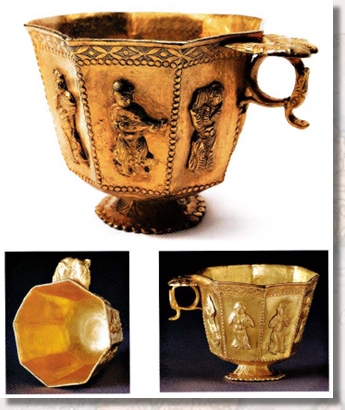
Unter der geborgenen Ladung befand sich zudem goldenes Geschirr sowie der größte, jemals aus der Tang Dynastie gefundene Trinkbecher aus purem Gold!
- - -
Zurück zur Phoenicia:
Wir haben Kontakt zu weiteren Mitgliedern des Phoenicia Teams, insbesondere auch der Crew.
Diese Kontakte bezeichne ich jetzt mal sehr vorsichtig als
„momentan leicht gedämpft“.
Inzwischen hat uns Richard Kellie, Kanadier, der die Phoenicia als Teil der Besatzung von Hodiedah nach Aden begleitete, zunächst mal 40 Fotos aus dieser Zeit auf meine Anfrage hin zur Verfügung gestellt. Es sind sehr schöne Bilder dabei, sie wirken zumindest auf mich sehr „lebendig“.
- - -
Als die Phoenicia damals ihre erste Etappe… „durcheierte“, haben sich einige von Euch hier im Thread kritisch über die scheinbar mangelnde Vorbereitung geäußert-
Ganz offensichtlich zu recht!
Ich persönliche wäre durchaus interessiert, diese kritische Diskussion hier noch mal wach zu rufen. Denn die Frage von damals ist ja heute mindestens ebenso berechtigt:
Was ist sie nun tatsächlich, diese „Phoenician Expedition“?
Nick Burningham etwa wird auf dem Blog der Phoenician so vorgestellt:
Nick Burningham
Marine Archaeologist
Nick Burningham is an acknowledged expert on maritime archaeology. He has been responsible for five reconstructions of historic craft. His recent projects include include the design and construction of the replica of the Dutch ship “Dufken” which was the first historically recorded ship to visit Australia and the design and build of the replica 8th Century double outrigger vessel for the Borobudur Ship Expedition.
Nick has contributed to the design specification for the replica Phoenician/Mediterranean vessel and is also supervising the building of the vessel in Arwad.
Er selbst hat nun hier bei uns eine etwas „diffenziertere“ Version dargelegt...
Interessant bleibt diese „Expedition“ ja weiterhin unter diversen Aspekten- nicht zuletzt auch gerade unter DIESEM.
Gruß an alle Interessierten
Micha
Bevor Nick nach China aufgebrochen ist, um dort unter anderem einen Vortrag über-
ich wiederhole dies mit einem leichten Grinsen-
die Unterschiede zwischen einer Replik und einer Rekonstruktion zu halten…
hat er uns noch einen Hinweis dagelassen:
Hi
Euch könnte vielleicht auch noch das "Jewel of Oman" (Juwel des Omans) Projekt interessieren.
http://www.jewelofmuscat.tv/
Ich habe diese Replik entworfen. Die Website erzählt leider nicht viel über die Archäologie, die hinter dem Projekt steht.
Es basiert auf einem Schiffswrack das 1998 auf der Insel Belitung in Indonesien gefunden wurde. Die Fracht bestand zum größten Teil aus Porzellan aus der chinesischen Tang Dynastie-
um die 60 000 Stücke.
Die Schiffskonstruktion deutet darauf hin, dass es aus Arabien, Persien oder Indien stammt. Analysen des Holzes zeigten zudem auf, das ein großer Teil davon einer Spezies angehört, die nur in Afrika wächst, also ist es wahrscheinlich eher ein arabisches oder persisches Schiff als ein indisches.
Es gibt Theorien, dass dieses Schiff aus Südostasien entstammt, da südostasiatisches Werkzeug es in Stand gehalten zu haben scheint.
In jedem Falle ist eine sehr deutliche Verbindung, eine frühzeitliche „Globalisierung“ zwischen Arabien und Asien impliziert.
Nick Burningham
- - -
Hier noch ein Link zu einem auch bebilderten BBC- Artikel über das Wrack und seine Ladung
http://news.bbc.co.uk/2/hi/programmes/f ... 675866.stm
Hier ein weiterer Artikel mit Bildern der äußerst gut erhaltenen Ladung
http://idlethink.wordpress.com/2009/07/ ... pores-past
Und hier ein Wiki über chinesisches Porzellan, auch in Bezug auf die verschiedenen Dynastien etc.
http://de.wikipedia.org/wiki/Chinesisches_Porzellan
Für die goldgierigen Piraten:
Unter der geborgenen Ladung befand sich zudem goldenes Geschirr sowie der größte, jemals aus der Tang Dynastie gefundene Trinkbecher aus purem Gold!
- - -
Zurück zur Phoenicia:
Wir haben Kontakt zu weiteren Mitgliedern des Phoenicia Teams, insbesondere auch der Crew.
Diese Kontakte bezeichne ich jetzt mal sehr vorsichtig als
„momentan leicht gedämpft“.
Inzwischen hat uns Richard Kellie, Kanadier, der die Phoenicia als Teil der Besatzung von Hodiedah nach Aden begleitete, zunächst mal 40 Fotos aus dieser Zeit auf meine Anfrage hin zur Verfügung gestellt. Es sind sehr schöne Bilder dabei, sie wirken zumindest auf mich sehr „lebendig“.
- - -
Als die Phoenicia damals ihre erste Etappe… „durcheierte“, haben sich einige von Euch hier im Thread kritisch über die scheinbar mangelnde Vorbereitung geäußert-
Ganz offensichtlich zu recht!
Ich persönliche wäre durchaus interessiert, diese kritische Diskussion hier noch mal wach zu rufen. Denn die Frage von damals ist ja heute mindestens ebenso berechtigt:
Was ist sie nun tatsächlich, diese „Phoenician Expedition“?
Nick Burningham etwa wird auf dem Blog der Phoenician so vorgestellt:
Nick Burningham
Marine Archaeologist
Nick Burningham is an acknowledged expert on maritime archaeology. He has been responsible for five reconstructions of historic craft. His recent projects include include the design and construction of the replica of the Dutch ship “Dufken” which was the first historically recorded ship to visit Australia and the design and build of the replica 8th Century double outrigger vessel for the Borobudur Ship Expedition.
Nick has contributed to the design specification for the replica Phoenician/Mediterranean vessel and is also supervising the building of the vessel in Arwad.
Er selbst hat nun hier bei uns eine etwas „diffenziertere“ Version dargelegt...
Interessant bleibt diese „Expedition“ ja weiterhin unter diversen Aspekten- nicht zuletzt auch gerade unter DIESEM.
Gruß an alle Interessierten
Micha
Zuletzt geändert von mikepiller am Mi 4. Nov 2009, 22:43, insgesamt 1-mal geändert.
Wenn der Wind des Wandels weht,
bauen die einen Windmühlen,
die anderen bauen Mauern.
(chin. Sprichwort)
bauen die einen Windmühlen,
die anderen bauen Mauern.
(chin. Sprichwort)
-
mikepiller
- Beiträge: 952
- Registriert: Sa 13. Mai 2006, 20:59
- Wohnort: Berlin
Re: Rund um Afrika in einem phönizischen Boot
Für alle, die sich tiefer für Nicks Arbeit interessieren:
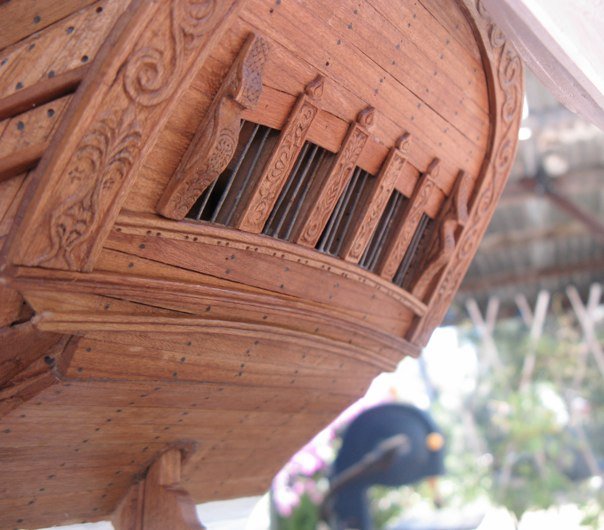
Er hat uns noch 2 Gallerien mit äußerst detailgetreuen Modellen von ihm zur Verfügung gestellt:
Gallerie 1) Eine arabische Dhau- 11 Bilder
http://de.wikipedia.org/wiki/Dhau
Gallerie 2) Modelle einer Jong (Dschunke) und einer Pattamar (indischer Schiffstyp- 21 Bilder
http://de.wikipedia.org/wiki/Dschunke
http://de.wikipedia.org/wiki/Pattamar
Es sind kleine Modelle- ich schätze mal etwa 30cm, andere erscheinen mir etwas größer... aber äußerst originalgetreu aussehend!
Keine Ahnung, wie groß das Interesse hier ist-
meldet Euch ggf. erst mal per PM bei mir.
Gruß
Micha
Er hat uns noch 2 Gallerien mit äußerst detailgetreuen Modellen von ihm zur Verfügung gestellt:
Gallerie 1) Eine arabische Dhau- 11 Bilder
http://de.wikipedia.org/wiki/Dhau
Gallerie 2) Modelle einer Jong (Dschunke) und einer Pattamar (indischer Schiffstyp- 21 Bilder
http://de.wikipedia.org/wiki/Dschunke
http://de.wikipedia.org/wiki/Pattamar
Es sind kleine Modelle- ich schätze mal etwa 30cm, andere erscheinen mir etwas größer... aber äußerst originalgetreu aussehend!
Keine Ahnung, wie groß das Interesse hier ist-
meldet Euch ggf. erst mal per PM bei mir.
Gruß
Micha
Wenn der Wind des Wandels weht,
bauen die einen Windmühlen,
die anderen bauen Mauern.
(chin. Sprichwort)
bauen die einen Windmühlen,
die anderen bauen Mauern.
(chin. Sprichwort)
-
mikepiller
- Beiträge: 952
- Registriert: Sa 13. Mai 2006, 20:59
- Wohnort: Berlin
Re: Rund um Afrika in einem phönizischen Boot

Hi,
Richard kann man ohne zu zögern einen "bunten Hund" nennen.
Seine Interessen, seine Hobbies, seine Reisen würden zig Seiten füllen.
Ich hoffe, wir hören ihn hier noch mit einem Statement zur Phoenicia.
Zunächst also ein paar seiner Bilder, die er uns zur Verfügung stellt:
Zunächst Richard selbst in den Seilen:
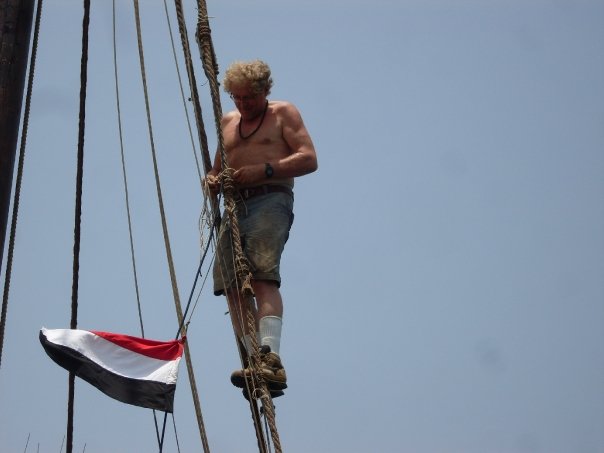
Dieser Kraftakt wird von John Bainbridge vollbracht- er hat seinen Bachelor abgeschlossen, hat dann auf der Phoenicia die schwierigsten Etappen komplett mitgemacht und ist nun wieder auf der Uni- seinen Master im Visier! Auch er wollte sich noch melden, hat aber sicherlich mit seinem Studium mächtig zu tun und...naja, schauen wir mal.

Hier noch einmal John und Philip Beale- der Leiter der Expedition- und im Hintergrund Nigel Fransham:
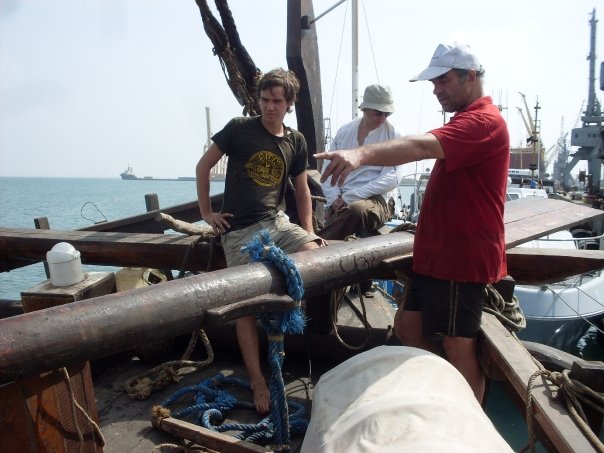
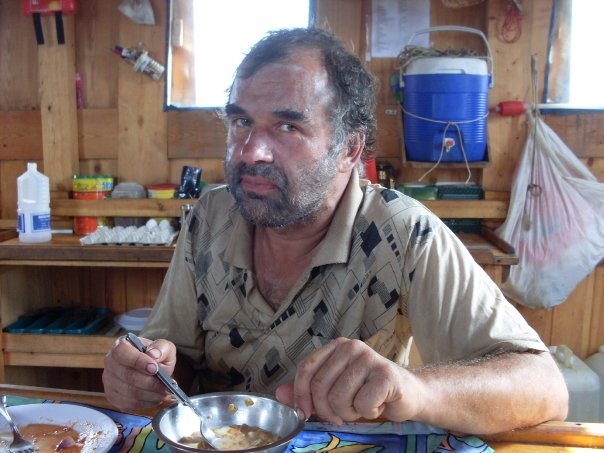
Die folgende Serie hat Richard so beschrieben:
Yemenitische Fischer schenken der Besatzung frischen Fisch:

Abdul, Faril und Ali genießen den Fisch:

Der Käpt´n Philip Beale... has his doubts.
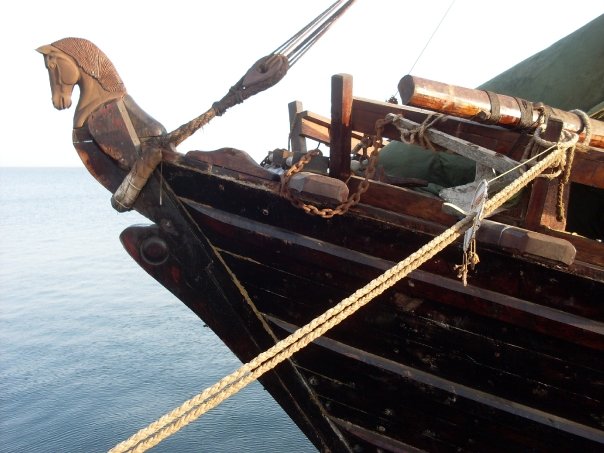
Die Phoenicia von oben:
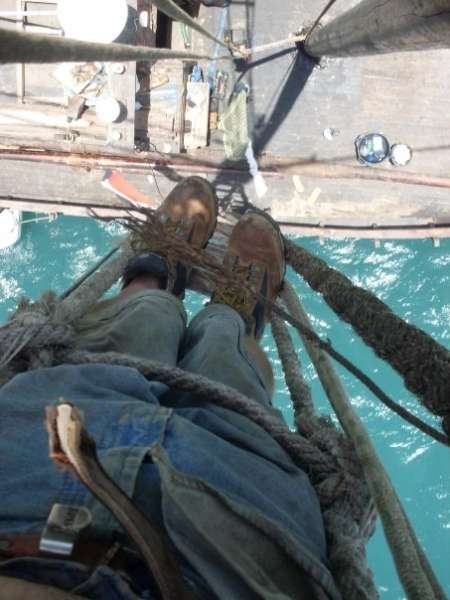
und noch die letzten, rausgesuchten Bilder:

Gruß
Micha
Wenn der Wind des Wandels weht,
bauen die einen Windmühlen,
die anderen bauen Mauern.
(chin. Sprichwort)
bauen die einen Windmühlen,
die anderen bauen Mauern.
(chin. Sprichwort)
-
mikepiller
- Beiträge: 952
- Registriert: Sa 13. Mai 2006, 20:59
- Wohnort: Berlin
Re: Rund um Afrika in einem phönizischen Boot
Hier der neueste Blog- Report:
Position Report 60
Date: 5th November 2009
Location:
10.29.1 N, 58.22.4 E
Message: Blog 6 on passage Oman-Tanzania from Captain Philip Beale
We have made fairly good progress over the last 24 hours. Winds have been around 20 knots and have meant we have been able to cover just under a 100 miles over the period on a heading of 150 degrees. Stronger winds and waves of about 3 meters pushed us to sailing southwards overnight so the waves were not on the beam of the ship. Whilst this was a little faster it has meant we are still about 150 miles too close to the Somali coast for comfort. Hopefully over the next few days we will get the easterly longitude we are looking for and then we will head south towards the Seychelles.
This morning we caught sight of a small Somali trading vessel heading north east. Naturally our hearts were in our mouths as we speculated what the vessel might be and whether any fast pirate skiffs might appear. Time passed slowly as the vessel remained on the horizon until out of sight and we could breath more easily.
The galley has been decorated with a large Omani flag and picture of the Sultan in readiness for celebrating Oman's national day on 18th November. Having caught two fish yesterday we have had no luck today except for a handful of suicidal flying fish which landed on deck over night.
Es gibt auch endlich wieder sehr viele neue Fotos in der Gallerie der offiziellen Website-
wer einen Blick werfen will:
http://www.phoenicia.org.uk/educating-p ... of%20Yemen
Gruß
Micha
Position Report 60
Date: 5th November 2009
Location:
10.29.1 N, 58.22.4 E
Message: Blog 6 on passage Oman-Tanzania from Captain Philip Beale
We have made fairly good progress over the last 24 hours. Winds have been around 20 knots and have meant we have been able to cover just under a 100 miles over the period on a heading of 150 degrees. Stronger winds and waves of about 3 meters pushed us to sailing southwards overnight so the waves were not on the beam of the ship. Whilst this was a little faster it has meant we are still about 150 miles too close to the Somali coast for comfort. Hopefully over the next few days we will get the easterly longitude we are looking for and then we will head south towards the Seychelles.
This morning we caught sight of a small Somali trading vessel heading north east. Naturally our hearts were in our mouths as we speculated what the vessel might be and whether any fast pirate skiffs might appear. Time passed slowly as the vessel remained on the horizon until out of sight and we could breath more easily.
The galley has been decorated with a large Omani flag and picture of the Sultan in readiness for celebrating Oman's national day on 18th November. Having caught two fish yesterday we have had no luck today except for a handful of suicidal flying fish which landed on deck over night.
Es gibt auch endlich wieder sehr viele neue Fotos in der Gallerie der offiziellen Website-
wer einen Blick werfen will:
http://www.phoenicia.org.uk/educating-p ... of%20Yemen
Gruß
Micha
Wenn der Wind des Wandels weht,
bauen die einen Windmühlen,
die anderen bauen Mauern.
(chin. Sprichwort)
bauen die einen Windmühlen,
die anderen bauen Mauern.
(chin. Sprichwort)
-
Kuno
- Beiträge: 9584
- Registriert: Mi 3. Mai 2006, 10:21
- Wohnort: Dort wo andere Ferien machen.
- Kontaktdaten:
Re: Rund um Afrika in einem phönizischen Boot
Gefallt mir immer besser :D
-
Regula St.
- Beiträge: 469
- Registriert: Sa 10. Mai 2008, 18:00
- Wohnort: Küssnacht am Rigi
Re: Rund um Afrika in einem phönizischen Boot
Ich freue mich natürlich auch, dass die Phoenicia ihre Kinderkrankheiten offenbar überwunden hat und jetzt ordentlich vorwärts kommt.
Allerdings bleiben mir immer noch einige Fragezeichen, gerade im Hinblick auf den Anspruch, den das Projekt erhebt.
In der experimentellen Archäologie gilt der Grundsatz, dass mit den zu einer bestimmten Zeit verfügbaren Mitteln gearbeitet wird (und das kann schon bei kleinen Dingen wie z.B. Fäden spinnen oder Kochen oder Töpfe herstellen und brennen extrem aufwendig sein!). Wenn ich die Antwort von Nick auf Alexanders Frage anschaue, ist dieses Prinzip eben gerade hier nicht vollständig zum Tragen gekommen:
LG Regula
Allerdings bleiben mir immer noch einige Fragezeichen, gerade im Hinblick auf den Anspruch, den das Projekt erhebt.
In der experimentellen Archäologie gilt der Grundsatz, dass mit den zu einer bestimmten Zeit verfügbaren Mitteln gearbeitet wird (und das kann schon bei kleinen Dingen wie z.B. Fäden spinnen oder Kochen oder Töpfe herstellen und brennen extrem aufwendig sein!). Wenn ich die Antwort von Nick auf Alexanders Frage anschaue, ist dieses Prinzip eben gerade hier nicht vollständig zum Tragen gekommen:
Aber, wie auch immer: es ist spannend und wir dürfen uns in die Welt hinaus träumen...However, he engaged modern naval architects who designed a modern yacht with a bit of Phoenician styling.
LG Regula